Best Whole House Filter for Iron Removal: Top Systems for Clean Water
Choosing a whole-house filter to remove iron means evaluating filtration stages, flow, and maintenance. This guide highlights five reliable systems designed to reduce iron and manganese while protecting plumbing and appliances. Each option balances performance, cartridge life, and ease of installation, helping American households decide between well-water and municipal-supply applications. Review the table for a quick comparison, then explore in-depth sections for practical installation considerations and buying tips.
| Product | Brand | Key Benefit | Notes |
|---|---|---|---|
| iSpring WGB32BM | iSpring | 3-Stage iron/manganese removal | Up to 100,000 gal; 15 GPM |
| Waterdrop WD-WHF21-FG | Waterdrop | 5-Stage filtration for iron/manganese | Up to 6 months between replacements |
| Express Water Iron & Manganese 3-Stage | Express Water | 3-stage system; reduces iron/manganese | Stainless bracket; gauges |
| iSpring WGB21BM 2-Stage | iSpring | Two-stage iron/manganese reduction | Up to 50,000 gal; DIY install |
| PRO+AQUA Heavy Duty Whole House | PRO+AQUA | Heavy-duty iron removal for multi-bath homes | Well-water oriented; auto-flush display |
iSpring WGB32BM: 3-Stage Iron Filter

The iSpring WGB32BM uses a three-stage approach to tackle iron, manganese, sediment, chlorine, rust, and other contaminants. The third-stage FM25B is specifically designed for iron and manganese removal, reducing iron up to 3.0 ppm and manganese up to 1.0 ppm. The first-stage polypropylene sediment filter catches particles down to 5 microns, while the second-stage carbon block (coconut shell carbon) enhances filtration efficiency and filter life. With a capacity of up to 100,000 gallons and a flow up to 15 GPM, this system maintains steady water pressure for typical family use.
Installation and maintenance are DIY-friendly, featuring 1 in NPT inlet/outlet connections and 20″ x 4.5″ cartridges. Both filters are independently tested to meet NSF/ANSI standards, providing third-party validation of performance. Routine maintenance centers on cartridge replacement, with the design aiming to minimize pressure drop while delivering reliable filtration across a full year of use for a family of four.
In practice, the WGB32BM suits homes facing moderate iron challenges without requiring complex plumbing changes. The combination of a robust iron filter with sediment and carbon stages offers broad contaminant reduction and a straightforward replacement cycle, making it a solid all-around choice for many households.
Waterdrop 5-Stage Whole House Filter

Waterdrop’s WD-WHF21-FG delivers a comprehensive 5-stage filtration path designed for iron and manganese reduction with additional taste-and-odor controls. The system pairs an iron/manganese reducing stage with a coconut-shell GAC filter to address chlorine, rust, and other impurities. In performance terms, it can reduce iron up to 99.3%, manganese up to 96.8%, and chlorine up to 95.63% under typical conditions, delivering noticeably fresher-tasting water at all taps.
Durability and replacement are built into the design: the filters are rated for up to six months between changes in ordinary US water conditions, helping to minimize ongoing costs. The unit features a straightforward 1″ inlet/outlet and a standard 10″ x 4.5″ housing size, which fits most residential filtration setups. It has also undergone testing for water hammer and regular pressure conditions up to 90 psi, ensuring reliability in daily use.
For households seeking clear taste improvement and robust iron/manganese control without complex maintenance, Waterdrop’s 5-stage model offers a balanced blend of filtration depth and practical upkeep.
Express Water Iron & Manganese 3-Stage

Express Water’s Iron & Manganese 3-Stage Whole House Filtration System emphasizes a dedicated tri-stage approach to reduce iron and manganese while removing sediment and chlorine tastes. The system is designed to address reddish-brown staining on glassware, fixtures, and laundry, and to improve overall water clarity and flavor. In addition to filtration, Express Water provides a deluxe mounting setup—a heavy-duty stainless steel bracket and free-stand frame—along with practical features such as pressure release buttons for each filter and integrated pressure gauges to monitor system health and filter changes.
Key specifications include 1″ inlet/outlet connections and a capacity suitable for many family households. The 3-stage arrangement works to alleviate common iron-related issues from well-water or municipal supplies, helping protect pipes and appliances while delivering consistently cleaner water from every faucet. The design emphasizes ease of maintenance and straightforward filter changes as part of routine care.
iSpring WGB21BM 2-Stage Filter
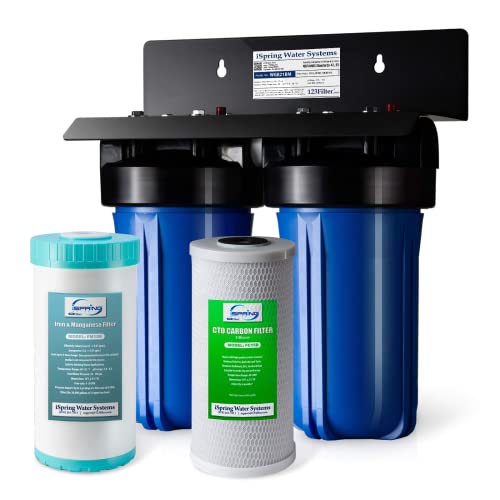
The iSpring WGB21BM is a two-stage whole-house filtration system designed for households with moderate iron and manganese loads. The first-stage CTO carbon block reduces cloudiness, chlorine, tastes, and odors, while the second-stage FM15B targets iron and manganese, lowering iron from a high starting point toward sub-ppm levels (down to about 0.01 ppm) and similarly reducing manganese. The system is built for easy DIY installation with pre-assembled components and standard 1″ ports, supporting up to 15 GPM flow and up to 50,000 gallons of filtered water for a family of four, depending on usage.
Construction emphasizes ease of maintenance and filtration efficiency, with third-party testing to meet NSF/ANSI standards. The WGB21BM serves as a practical entry point for households seeking reliable iron control at a lower initial investment while maintaining solid performance for everyday water needs.
PRO+AQUA Heavy Duty Whole House Well Water Filter

PRO+AQUA’s Heavy Duty Whole House Well Water Filter is designed for larger households and well-water supplies, including 4+ bathrooms. The system claims broad contaminant reduction, including iron, hydrogen sulfide, manganese, heavy metals, odors, VOCs, pesticides, and more. It is explicitly noted that this model does not reduce total dissolved solids (TDS). A standout feature is a fully programmable backlit digital display with automatic controls to customize auto-flush intervals and system monitoring, simplifying maintenance and ensuring consistent performance in varying well-water conditions.
The filter set targets a wide range of impurities and is positioned as a durable, heavy-duty option for homes with higher filtration needs. Its emphasis on automation and monitoring makes ongoing maintenance more predictable, while the well-water orientation highlights its suitability for private wells and residences with higher contaminant loads.
Buying Guide: Key Factors For Choosing An Iron-Removal Whole-House Filter
When selecting a whole-house filter to control iron, manganese, and related contaminants, consider the following factors to match your water source, usage, and maintenance preferences:
- Water source and contaminant profile: Well water often contains higher iron and sulfides, while municipal water may present different tastes or chlorination byproducts. Match media to your primary contaminants (iron/manganese vs chlorine/taste and odor).
- Filtration stages and media: Three-stage iron filters with catalytic media can provide strong iron removal, while five-stage systems with GAC can improve taste and odor alongside iron control. Assess whether you need a dedicated iron/manganese stage or a broader multi- contaminant approach.
- Flow rate and capacity: Look for GPM capability that supports your home’s peak demand. Systems rated at 15 GPM or more typically handle typical family usage without noticeable pressure drops; capacity (gal or years between changes) affects maintenance frequency and cost.
- Inlet/outlet size and cartridge dimensions: Most residential systems use 1″ fittings and standard 20″ x 4.5″ cartridges. Confirm compatibility with existing plumbing and housing dimensions.
- Maintenance and replacement cycles: Some filters require frequent changes (e.g., every 6 months); others offer longer intervals. Consider the total cost of ownership, including media replacement and labor (DIY vs professional).
- Installation complexity: DIY-installable systems offer cost savings but may require basic plumbing skills. Check for pre-assembled brackets, mounting hardware, and clear manuals or video tutorials.
- Certifications and third-party testing: NSF/ANSI certifications provide independent validation of contaminant reductions. This helps ensure the system performs as advertised under tested conditions.
- Space, aesthetics, and noise: Mounting space, display panels, and potential noise from purge or backflush features may influence placement in utility rooms or basements.
- Warranty and service: Review warranty length and coverage, as well as available customer support and replacement parts access for long-term reliability.
Overall, your best choice balances iron-removal effectiveness with installation practicality and ongoing maintenance needs. For homes with higher iron loads or well-water sources, a three- to five-stage approach with catalytic media and a durable bracket system often yields the most consistent results. For simpler setups or lower iron levels, a two-stage system may deliver satisfactory performance at a lower upfront cost.