In this guide
Small evaporative coolers provide efficient, low-energy cooling for hot, dry spaces. They’re ideal for desks, bedrooms, studios, or small offices where a full-sized air conditioner isn’t practical. Evaporative cooling uses water to lower air temperature, offering relief without refrigerants. This guide highlights five compact, easy-to-use models that balance airflow, water capacity, and portability to fit limited spaces and budgets.
Below is a quick summary table of the five picks, followed by detailed profiles and a buying guide to help you compare features and performance.
| Product | Brand | Key Strength |
|---|---|---|
| BLACK+DECKER Desktop Air Cooler | BLACK+DECKER | Desk-friendly, 0.5L tank, 8-hour run time |
| Hessaire DC18 Mobile Evaporative Cooler | Hessaire | 900 CFM, 300 sq ft coverage |
| Hessaire MC18V Portable Evaporative Cooler | Hessaire | 1,300 CFM, compact footprint |
| JRD Portable Evaporative Cooler With Remote | JRD | Remote control, 12H timer, 4 modes |
| JRD Portable Evaporative Cooler With Ice Packs | JRD | Top-fill dual tank, ice packs, 3 speeds, 4 modes |
BLACK+DECKER Desktop Evaporative Cooler

The BLACK+DECKER BDMC10B offers compact, desk-side cooling with a small footprint. It uses evaporative cooling with a 0.5-liter water tank and runs up to eight hours per refill when powered via the included micro-USB. It provides three speed settings for customizable airflow and prioritizes ease of use in tight spaces. This unit is ideal for a personal workspace, dorm room, or bedside table where a simple, portable cooling solution is preferred. It is not an air conditioner and works best in dry environments where humidity is moderate to low.
Operation is straightforward: fill the tank, plug in, switch on, and enjoy. Its compact design makes it easy to move between rooms, and the absence of refrigerants means fewer maintenance concerns. For larger rooms or high-humidity climates, a higher-CFM model may be a better fit. This desk cooler focuses on convenience and portability without sacrificing essential evaporative cooling benefits.
Hessaire DC18 Portable Evaporative Cooler

The Hessaire DC18 delivers portable cooling with 900 CFM airflow and coverage up to 300 square feet. It cools by pulling hot air through a water-soaked filter, then circulating cooler air throughout the space. As a dedicated evaporative cooler, it does not rely on refrigerants, making it a greener option for rooms, garages, or workshops where immediate relief from heat is needed. Its compact, mobile design supports easy relocation as temperatures shift during the day or week.
With simple operation and a focus on efficiency, the DC18 provides reliable performance in small-to-medium spaces. It’s well-suited for users who want a straightforward, low-maintenance cooling solution without complex features. For areas with higher humidity, its cooling effect may be reduced, which is typical for evaporative units. This model emphasizes value and practicality for quick, local cooling.
Hessaire MC18V Portable Evaporative Cooler
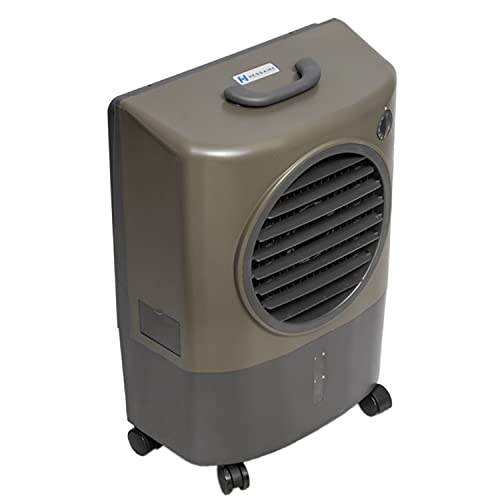
The Hessaire MC18V provides about 1,300 CFM of airflow, making it suitable for small-to-mid sized living rooms, studios, or workshops. It uses evaporative cooling to reduce air temperatures in dry climates, and it increases humidity, which can improve comfort in arid environments. Its compact footprint helps it fit into tighter spaces without sacrificing significant cooling capacity. It is designed for straightforward operation with a focus on energy efficiency compared with refrigerant-based cooling options.
In dry areas, the MC18V can deliver meaningful comfort with minimal energy use. It’s not ideal for consistently humid rooms, but for spaces that need portable, quick relief from heat, this unit offers strong performance with a relatively lightweight design. Consider this model when you want a balance of airflow and portability without carrying a larger appliance.
JRD Portable Evaporative Cooler With Remote

This JRD model combines versatility with convenience. It offers 3 speeds and 4 modes, plus a 12-hour timer and a mist function to enhance cooling when needed. The unit supports remote control from up to 16 feet, making it easy to adjust settings from across a room. Wide 80-degree oscillation helps distribute air more evenly across a workspace or bedroom. A top-fill design and 2.4-gallon tank reduce the frequency of refills, making it a practical option for small apartments and home offices.
Remote operation and multiple modes provide flexibility for different preferences and environments. It’s particularly suitable for users who want customizable airflow without moving the unit. While it’s compact enough for personal use, a larger room may benefit from a higher-CFM model. Overall, this cooler prioritizes user-friendly controls and flexible cooling scenarios.
JRD Portable Evaporative Cooler With Ice Packs

This JRD model emphasizes dual-tank capacity and ice-pack-assisted cooling. It offers a 3-in-1 evaporative cooling experience with 3 speeds and 4 modes, plus a timer and mist function. The top-fill dual tank design simplifies refilling and ensures extended operation. The unit includes ice packs to boost cooling performance during peak heat. It is well-suited for bedrooms, home offices, or small living spaces where consistent comfort is desired without heavy equipment.
With multiple modes and easy top-fill operation, this cooler suits users who appreciate longer run times between refills and enhanced cooling during hot days. It maintains portability and quiet operation, making it a viable option for small apartments, dorm rooms, or shared offices. As with other evaporative coolers, effectiveness improves in dry climates and may be limited by high humidity levels.
Buying Guide
Altering comfort with a compact evaporative cooler involves balancing space, climate, and user needs. Here are key purchase considerations and practical comparisons to help you decide which model fits best.
- Room size and airflow: Match CFM and coverage to your space. Smaller desks or bedrooms benefit from units under 1,000 CFM, while larger rooms may require higher airflow. Look for clear coverage specifications in product descriptions.
- Water capacity and run time: A larger water tank means fewer refills. If you’ll use the cooler for extended periods, prioritize models with bigger tanks or top-fill dual tanks.
- Climate and humidity: Evaporative cooling excels in dry climates where humidity remains low. In humid environments, effectiveness decreases. For very humid spaces, consider alternatives or use in conjunction with dehumidification.
- Portability and footprint: If you plan to move the unit between rooms, check for handles, wheels, and a compact footprint. Weight and dimensions influence how easily you can reposition the unit.
- Controls and automation: Remote controls, timers, mist options, and programmable modes add convenience. Ensure compatibility with your preferred control method (remote, panel, or both).
- Maintenance: Evaporative coolers require periodic pad and filter cleaning or replacement, and regular water refilling. Look for models with accessible, easy-to-clean components.
- Noise level: Some compact units operate quietly, while others may generate noticeable fan noise at higher speeds. If the cooler will be near a bed or workspace, check decibel ratings or user reviews for sound levels.
- Energy efficiency: Evaporative coolers typically use less electricity than traditional air conditioners. Compare wattage and energy-saving features to estimate ongoing costs.
- Accessories and extras: Ice packs and extra cooling pads can boost performance. Verify what accessories are included or separately available for your chosen model.
- Warranty and support: A reliable warranty helps protect your investment. Review coverage terms and vendor support options before purchase.
Bottom line: For very small spaces and controlled climates, desk- or tabletop-friendly evaporative coolers provide efficient, low-maintenance relief. For larger rooms, look for higher-CFM models that remain portable, and consider units with larger water capacity and flexible controls. Always assess humidity, room size, and usage patterns to select the best combination of airflow, ease of use, and energy efficiency.