Best Salt Level for Pools: How to Balance Saltwater Safely
Maintaining the right salt level is essential for safe swimming and effective chlorine generation in saltwater pools. Too little salt can reduce chlorine production, while too much can stress equipment and irritate skin. Digital meters and test strips offer different ways to monitor salinity, with readings often shown in parts per million (ppm) or practical equivalents like ppt. This guide highlights five popular testers and provides a buying guide to help American pool owners choose the right tool for their saltwater setup.
Summary of chosen products:
| Brand | Model | Type | Key Benefit |
|---|---|---|---|
| eSeasonGear | SALT-3050 | Digital Salinity Meter | Precalibrated, IP65 waterproof, quick readings |
| Hofun | Digital Salinity Meter & PH Tester | 5-in-1 Digital Tester | Multiple units (ppm, ppt, %), versatile for pools and aquariums |
| YUZIIB | Salt Tester For Saltwater Pool | 5-in-1 Digital Tester | High accuracy with titanium probes, fast results |
| ORAPXI | Salt And pH Meter | 5-in-1 Digital Meter | Clear digital readings, supports pool and spa use |
| AquaChek | Salt Test Strips Kit | Test Strips | Professional-level accuracy, quick color-match readings |
eSeasonGear SALT-3050 Salinity Meter
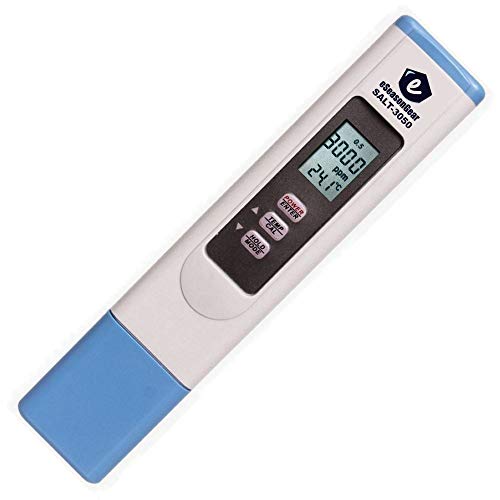
The SALT-3050 is designed for saltwater pools and koi ponds with a focus on ease of use and durability. It ships preset to a 0.5 salt mode, eliminating mode selection for most users. Calibrated at 3000 ppm NaCl at 25°C (77°F), it covers a broad salt range from 0 to 9999 ppm and a temperature range of 0 to 55°C (32 to 130°F). Its IP65 waterproof rating protects against water exposure in pool environments. This model is ideal for quick checks during routine maintenance, delivering reliable results with minimal setup. The combination with TS107 test strips offers extended testing versatility for comprehensive water chemistry checks.
Users should note that reading interpretation benefits from understanding the unit scale used. The device supports a broad salt range suitable for most residential pools, and its built-in temperature compensation helps improve accuracy across seasonal temperature shifts. The rugged IP65 rating ensures it withstands splashes and outdoor use, making it suitable for backyard pools and outdoor koi ponds alike. This tester provides a balance of speed, convenience, and reliability for ongoing salt management.
Hofun Digital Salinity Meter & PH Tester
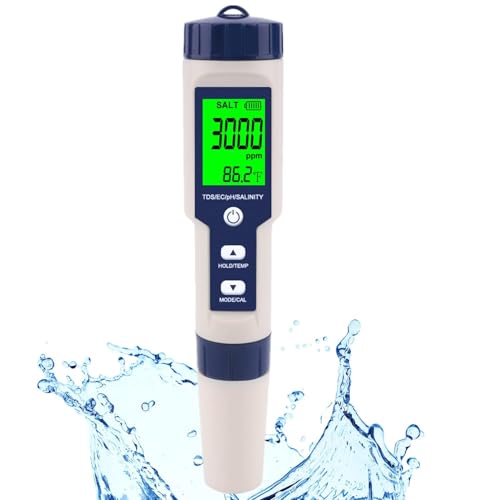
Hofun offers a 5-in-1 digital tester that combines salinity, pH, temperature, and additional readings for practical pool management. It presents salinity measurements in multiple formats—PPM, PPT, and percentage—to simplify conversions between common units used in pool maintenance and seawater testing. For swimming pools, Hofun provides a 0–9999 ppm range for salinity and 10–200 ppt for seawater, with automatic unit switching when readings exceed 9999 ppm to prevent manual calculations. The user-friendly interface reduces guesswork, enabling quick decision-making for chlorine generation and balancing.
This meter emphasizes ease of operation: turn on the device and press MODE to access SALINITY. The broad testing scope makes it suitable not only for pools but also for koi ponds, seawater aquariums, and hydroponics systems. The device’s design aims to minimize misreadings with intuitive displays and straightforward calibration, offering a practical solution for regular water testing without specialized training.
YUZIIB Salt Tester For Saltwater Pool
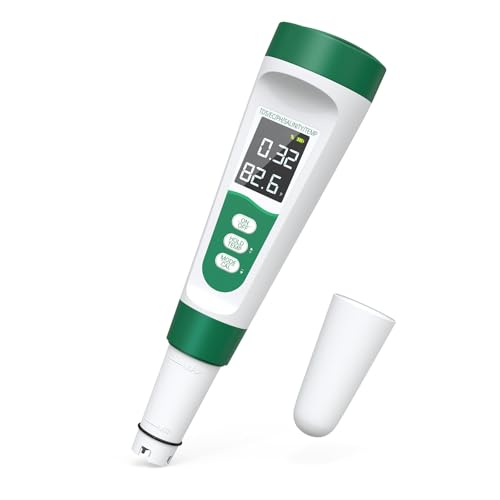
YUZIIB markets a 5-in-1 digital tester for saltwater pools, hot tubs, spas, and related environments. It provides five key metrics—salinity, pH, EC, TDS, and temperature—on a single handheld unit, enabling comprehensive water quality checks with a single device. The manufacturer emphasizes high accuracy, citing a ±2% measurement range, and highlights corrosion-resistant titanium alloy probes for durability in saline conditions. Readings are quick—typically a few seconds after immersion—facilitating timely adjustments to salinity levels and complementary parameters that influence chlorine production and water balance.
Designed for frequent testing, this model targets pool maintenance personnel and hobbyists who manage multiple water features. Its 5-in-1 capability helps streamline daily routines by reducing the number of separate instruments needed. While it offers robust performance, users should ensure proper calibration and probe care to maintain consistent accuracy over time in harsh pool environments.
ORAPXI Salt And pH Meter

ORAPXI presents a 5-in-1 digital tester designed for saltwater pools, hot tubs, and swim spas. It covers a salt range of 0–9990 ppm and a pH range of 0.00–14.00, with guidance on ideal pH typically between 7.2 and 7.8 depending on pool type. The device emphasizes the advantages of digital readings over test strips, noting that digital testers provide exact values and reduce estimation errors over time. The product aims to enable more efficient chlorination by aligning salinity with the chlorine generator’s requirements, while also offering straightforward checks of pH and related metrics.
In practice, users benefit from the clear numerical outputs that support quick adjustments to salinity and pH. The emphasis on digital accuracy helps maintain balanced water chemistry, supporting comfort and safety for bathers. As with all digital meters, regular calibration and probe maintenance are important to sustain long-term accuracy in saltier environments.
NewTest Pool Salt Test Strips

NewTest offers an 8-in-1 test strips package designed for pool and spa quality control. The 150-count strips provide readings for eight indicators, including salt, pH, free chlorine, total chlorine, total alkalinity, hardness, cyanuric acid, and salinity. The strips are marketed for ease of use and cost savings, with quick dipping and color-chart comparison. These strips are designed for frequent testing and are suitable for home pools, hot tubs, and spas that utilize salt systems. The kit is especially useful for routine checks and quick decision-making where a digital meter is not available.
The 8-in-1 design helps pool owners monitor multiple facets of water chemistry in one glance. While strips offer convenience and affordability, users should be aware that readings can be less precise than digital meters, particularly when calibrating complex systems or troubleshooting subtle imbalances. Regular cross-checks with a digital tester can help ensure overall accuracy.
SuperCheck Salt Test Strips

SuperCheck provides high-sensitivity salt test strips designed for measuring sodium chloride content in saltwater systems. These strips are useful for calibrating saltwater chlorine generators and verifying salt levels in pools and spas. The strips respond specifically to chloride-containing salts, making them a practical option for verifying generator performance and ensuring consistent sanitization. The kit emphasizes ease of use and readable results, with straightforward interpretation that helps users maintain appropriate salinity for safe chlorine generation.
Because these strips are designed for chloride-focused measurements, they excel in providing a quick cross-check against digital meters. Users should be mindful of unit compatibility and consider using a digital tester for precise readings, especially when managing residential pool systems with varying chlorine generation requirements.
Buying Guide
Key purchase considerations
- Measurement range and units: Ensure the device covers your pool’s typical salinity range (often 0–9990 ppm or 0–8000+ ppm) and can display in ppm or ppt as needed.
- Accuracy and calibration: Digital meters with clear accuracy specs (for example, ±2%) and easy calibration routines help maintain reliable readings over time.
- Unit versatility: 5-in-1 meters add convenience by combining salinity, pH, temperature, and other metrics in one tool, reducing gear clutter.
- Durability and water resistance: IP ratings (like IP65) protect the device from splashes and outdoor exposure in pool environments.
- Maintenance needs: Consider probe materials (e.g., titanium alloy), calibration frequency, and replacement parts to extend device life.
Digital meters versus test strips
- Digital meters provide precise, repeatable readings and quick results, but require calibration and care of probes.
- Test strips offer simplicity and low ongoing cost but can be less precise and require careful color interpretation.
Calibration, accuracy, and maintenance
Regular calibration against known standards ensures ongoing accuracy. Keep probes clean and store meters per manufacturer guidelines. Battery life and screen readability are practical considerations for routine use, especially in outdoor pools exposed to heat and sunlight.
Choosing by pool type
- Residential saltwater pools: Prioritize ease of use, reliable basic salinity readings, and quick calibration.
- Koi ponds and aquariums: Look for units that handle broader ranges and offer compatibility with additional water quality metrics.
- Saltwater spas and hot tubs: Consider devices with robust temperature measurement and resistant probes for warmer environments.