Best Geotextile Fabric for Pavers
Choosing the right geotextile fabric under pavers helps stabilize soil, improve drainage, and suppress weeds. This guide highlights five top options, comparing weight, durability, and installation features to help homeowners and contractors select the best underlayment for driveways, parking areas, and paths. Each choice balances strength with permeability, offering long-term performance when buried properly under gravel and pavers.
| Product | Brand | Key Benefit |
|---|---|---|
| Super Geotextile Woven Driveway Fabric | Super Geotextile | Heavy-duty 4 oz woven fabric for stabilization and long life |
| REKVEN Driveway Landscaping Fabric | REKVEN | Thick woven geotextile for soil separation and weed control |
| PioneerWorks Geotextile Landscape Fabric | PioneerWorks | 8 oz, high strength for heavy loads and drainage |
| Super Geotextile Non-Woven Landscape Fabric | Super Geotextile | 5 oz non-woven with filtration and durability |
| Sandbaggy 50 Year Woven Geotextile | Sandbaggy | 200-lb tensile strength, UV protected, long-term underlayment |
Super Geotextile Woven Driveway Fabric

Designed for heavy-duty driveways and road underlayment, this fabric is a true 4 oz polypropylene weave that delivers reliable stabilization beneath pavers and gravel. The woven construction provides high tensile strength while remaining dimensionally stable for long-term performance. Installation is straightforward with standardized roll widths that minimize scrap, and the fabric resists deformation over years of use. When buried properly, it helps reduce rutting and erosion, delivering durability that supports traffic and heavy loads for decades.
REKVEN Heavy Duty Landscape Fabric

REKVEN’s heavy-duty landscaping fabric delivers a robust underlayment for gravel drives, pathways, and patio projects. This thick woven geotextile provides essential soil separation, filtration, and stabilization to prevent mixing of soil layers, rut formation, and sinking over time. It supports water movement while blocking persistent weeds, reducing maintenance costs. Ideal for patios, walkways, decking, and garden beds, the fabric balances strength with breathability, helping you conserve soil integrity while enabling healthy drainage beneath gravel and pavers.
PioneerWorks Geotextile Landscape Fabric

Engineered as an 8-ounce non-woven geotextile, this PioneerWorks fabric emphasizes high strength with 350N tensile capacity to support heavy loads and maintain drainage pathways under pavement and driveways. The material is designed for erosion control and drainage projects, offering durability even under exposed weather. It is not a typical weed barrier, reflecting its heavy-duty purpose for major construction. Use it under concrete, asphalt, or stone to separate, drain, and protect subgrades, while allowing filtration and air movement for lasting performance.
Super Geotextile Non-Woven Landscape Fabric

At 5 ounces, this Super Geotextile non-woven fabric offers a balance of strength and permeability for garden beds, paths, and underlayment. The dual-property design includes a woven side for structural support and a needle-punched side to enhance filtration and moisture retention. It resists UV degradation and rot, delivering long-term durability even in sunny, damp climates. Easy to install with minimal waste, it can be cut to exact dimensions and installed beneath pavers or gravel to stabilize soil, suppress weeds, and promote even drainage.
Sandbaggy 50 Year Woven Geotextive
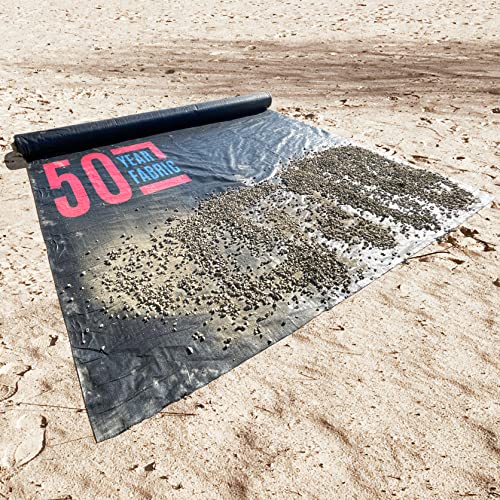
Built to last, Sandbaggy’s woven geotextile provides long-term stabilization for pavers, driveways, and gravel roads. Made from industrial-grade 4-ounce polypropylene, it resists tearing and delivers strong tensile strength for demanding environments. The fabric is UV-protected to extend life under sun exposure and is thick enough to accommodate vehicle traffic when topped with gravel. It offers reliable separation, filtration, and drainage while maintaining soil integrity under high-load conditions.
Buying Guide
- Fabric type and purpose: Choose woven fabrics for soil separation, stabilization, and load transfer under heavy traffic, and non-woven fabrics for filtration and drainage under lighter loads or where rapid water movement is needed.
- Weight and strength: Heavier weights (4 oz to 8 oz) typically offer greater tensile strength and longer life, essential for driveways and roads. Consider tensile strength figures (e.g., 350N) for expected loads.
- Permeability and drainage: Proper drainage helps prevent hydrostatic pressure and frost heave. Ensure the fabric allows water to pass while keeping soil particles in place.
- Durability and UV resistance: Look for UV protection and rot resistance for outdoor exposure. Long-term durability matters when pavers are installed on a sunlit, storm-prone site.
- Size, waste, and fit: Select roll sizes that minimize waste. Cut pieces to fit irregular areas and overlap gaps as needed to maintain stability.
- Weed suppression vs. soil separation: Weed barriers excel at blocking light and roots, while soil-separation fabrics keep soil layers apart to prevent rutting and mixing.
- Site suitability: For heavy vehicle traffic, prioritize reinforced, high-strength fabrics. For decorative paths, a lighter, permeable option may suffice.
- Installation tips: Clear debris, trench edges flush with surrounding ground, and cover with gravel or pavers per project specs. Overlap seams and secure edges as recommended by the manufacturer.
- Comparison snapshot:
- Best overall durability: Sandbaggy 50 Year and PioneerWorks for heavy loads and long life.
- Best budget-friendly option: REKVEN provides strong performance at a competitive price.
- Best weed suppression: Super Geotextile Professional 5oz offers robust weed control with added strength.
- Best for filtration and drainage: Super Geotextile Non-Woven 5oz balances filtration with stability.
For projects involving pavers, attach the underlayment to a well-prepared subgrade, ensure proper slope for drainage, and follow local building practices. The right geotextile fabric choice — considering weight, load, and drainage needs — supports a durable, even surface that remains stable over time while reducing maintenance.