Best Commercial Citrus Juicer for High-Volume Fresh Juice
For high-volume juice service, a commercial citrus juicer must deliver reliable yield, durable build, and easy cleaning. This guide rounds up five top performers spanning manual lever presses and electric countertop models. Each option targets busy kitchens, bars, and cafes needing consistent juice without lengthy prep. Durability, efficiency, and safety features are weighed to help operators select the right fit for daily use in professional settings.
Below, a quick product table provides a snapshot, followed by in-depth sections that highlight design, juice yields, maintenance, and best-use scenarios.
| Product | Brand | Notable Feature |
|---|---|---|
| Eurolux Cast Iron Commercial Juicer | Eurolux | Heavy-duty manual lever; stainless steel cup |
| Zulay Kitchen Cast-Iron Orange Juice Squeezer | Zulay Kitchen | Heavy-duty cast iron; comfortable grip; anti-slip base |
| Hamilton Beach Commercial 932 Manual Citrus Juicer | Hamilton Beach Commercial | 2000 lbs extraction force; enamel finish; Sure Grip Feet |
| Breville 800CPXL Citrus Press Pro Juicer Machine | Breville | Active-arm, power-assisted lever; Quadra-Fin cone |
| YUANHAO Commercial Stainless Steel Electric Citrus Juicer | YUANHAO | 3-size reamers; 1400 RPM; durable aluminum exterior |
Eurolux Cast Iron Commercial Juicer

This manual juicer is built for continuous operation in busy environments. The heavy-duty cast iron frame supports repeated presses with minimal flex, making it suitable for high-throughput tasks in bars, cafes, and catering setups. The dependable lever design translates to efficient juice extraction with less operator effort, a key advantage during long shifts. Cleaning is simplified by dishwasher-safe parts that detach easily from contact surfaces, reducing downtime between batches.
A stainless steel cup is included, ensuring a neutral, durable collecting vessel that resists staining and corrosion. The cup’s size accommodates a steady flow of juice into recipes, packaged drinks, or serving vessels without needing constant cup swaps. Overall, this model emphasizes durability, straightforward maintenance, and countertop-ready appeal for commercial kitchens seeking a robust manual option.
Zulay Kitchen Cast-Iron Orange Juice Squeezer

The Zulay Kitchen squeezer is designed to extract maximum juice from citrus with minimal mess. Its five-inch-diameter press bowl accepts a wide range of sizes, including lemons, limes, oranges, and grapefruits, allowing operators to process diverse fruit without switching tools. The manual lever delivers leverage that makes juicing quick, while the absence of electricity eliminates battery or motor concerns in a busy prep area.
Crafted from heavy-duty cast iron, this unit stays firmly in place thanks to a stable base, even during high-volume use. A rubberized base further reduces movement and helps protect countertops. The design also emphasizes clean-up simplicity, with surfaces that are easy to wipe down between batches and a straightforward assembly for quick sanitizing in professional kitchens.
In practice, this squeezer shines in beverage stations or salad bars where variety fruit is common. It is a reliable, cost-effective option for venues that prioritize manual operation, quiet performance, and durable materials without the complexity of an electric machine.
Hamilton Beach Commercial 932 Manual Citrus Juicer

This manual juicer emphasizes raw power for maximum juice extraction with minimal effort. The extractor arm delivers up to 2000 pounds (907 kg) of force, enabling thorough pressing even with tough peels or slightly thicker rinds. Designed for reliability, the unit uses durable metal components and an enamel finish that resists wear from citrus acids, ensuring a long service life in high-demand environments.
Stability is a key feature, with Sure Grip Feet that help prevent tipping and movement during operation. This design choice supports safe, consistent use across shifts, reducing the risk of spills or accidental slippage in busy prep areas. For venues prioritizing proven manual performance and simple maintenance, this model provides dependable juicing without the need for electricity.
Breville Citrus Press Pro Juicer Machine 800CPXL
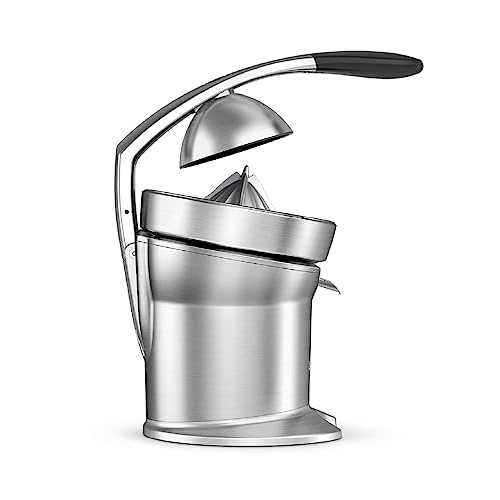
The Breville Citrus Press Pro is a motorized option designed for effortless juicing with a focus on convenience and efficiency. Its Active-arm press and power-assisted lever reduce effort and speed up throughput, making it suitable for service counters and beverage stations with high demand. The Quadra-Fin acid-resistant juicing cone is engineered to maximize extraction across a range of citrus sizes, from limes to grapefruits, delivering consistent quality juice.
Safety features are integrated through dual switches and a triple-hinged arm that ensures downward pressure is maintained during operation. The safety mechanism prevents the cone from spinning unless the user applies sufficient downward force, supporting operator safety in fast-paced environments. The Breville model blends user-friendly operation with dependable performance, ideal for venues seeking a more automated approach to citrus juice preparation.
YUANHAO Commercial Electric Citrus Juicer

The YUANHAO model is built for high-volume commercial use, featuring a professional-grade 120V motor and 1400 RPM operation. Its cast aluminum body with a protective coating resists citrus erosion, promoting durability in environments with steady juice production. The unit includes a 3-size Smart Citrus Press System with interchangeable reamers of 2.5″, 3.5″, and 4.5″ to accommodate a wide range of fruits while optimizing juice yield.
Impressive efficiency comes from a patent-pending ribbed design that claims to extract more juice while reducing pulp. Tool-free installation makes setup quick, and the overall system is designed for quick removal of parts for cleaning and sanitizing. This model targets facilities that require a robust electric option with flexible reaming options and a focus on maximizing juice yield per cycle.
Buying Guide
Choosing a commercial citrus juicer depends on your operation’s volume, space, and service style. The following factors help compare manual versus electric models and identify which features deliver the best return on investment in a professional setting.
- Volume and throughput: Manual juicers excel in smaller service windows or limited electrical access, while electric models are ideal for high-volume days. Consider average daily juice output and peak-hour needs when selecting a unit.
- Durability and materials: Cast iron and steel constructions offer long lifespans under constant use but may require more frequent cleaning. Aluminum and stainless steel provide corrosion resistance and lighter handling. Choose a build that aligns with your kitchen’s cleaning protocols and maintenance resources.
- Juice yield and efficiency: Tools with aggressive levers or high-pressure mechanisms can extract more juice per fruit, reducing waste. For electric models, look for advanced reaming systems and optimized cones or heads designed for citrus variety.
- Ease of cleaning: Removable parts that are dishwasher-safe save time during shift changes. Smooth, non-porous surfaces help prevent residue buildup and simplify sanitation protocols required by health codes.
- Footprint and installation: Space-constrained bars or cafe counters benefit from compact, low-profile units. Ensure the model can fit under cabinets or above sinks and has stable footing to prevent movement during use.
- Safety and certifications: NSF or equivalent certifications, anti-slip bases, and protective safety guards minimize risk in fast-paced service. Check warranty terms for coverage on motors, levers, and reamers.
- Maintenance and parts availability: Availability of replacement parts and accessories (cones, reamers, cups) reduces downtime and total cost of ownership over time.
- Noise and energy usage: Electric juicers introduce noise and power considerations. If the facility operates late hours, consider models with quieter operation or sound-dampening features.
- Warranty and service support: Longer warranties and local service networks help sustain operation in critical service environments.
When evaluating the five models highlighted here, match the format to your service needs. Manual options offer simplicity, low upfront cost, and reliability in environments with limited power access. Electric options deliver speed, consistency, and the ability to handle steady streams of fruit with less operator fatigue. For cafes, bars, and restaurants facing variable demand, a hybrid approach—having both manual and electric units—can provide flexibility and ensure you meet customer expectations without compromising efficiency.