In this guide
Sourdough bread demands precise slicing to preserve crust and crumb. The following manual bread slicers emphasize adjustable thickness, stable bases, and durable blades, helping home bakers achieve uniform slices for toast, sandwiches, and artisanal loaves. This list focuses on reliable, user-friendly options that work well with crusty sourdough and dense loaves alike. Below is a quick overview table of the 5 chosen models, followed by in-depth product details and a buying guide.
| Product | Brand | Adjustable Thickness | Notable Benefit |
|---|---|---|---|
| CAWIU Manual Bread Slicer with Hand Crank | CAWIU | Up to 0.9 inches | Wire guide keeps slices clean and away from the handle |
| Brvclon Manual Bread Slicer with Scale Line | Brvclon | 0 to 0.9 inches | Serrated blades and suction-cup stability |
| Vanerepok Manual Bread Slicer For Sourdough | vanerepok | Up to 0.8 inches | Steel wire guide rail and gear-drive for smooth cuts |
| Redants Manual Bread Slicer For Sourdough | Redants | 0 to 0.8 inches | Solid wood frame with non-slip suction cups |
| LukieBoee Bread Slicer For Sourdough | LukieBoee | Wide capacity (slot for large loaves) | Stop board and precise guides for consistent slices |
CAWIU Manual Bread Slicer For Sourdough

The CAWIU slicer uses a hand-crank mechanism to deliver consistent slices up to 0.9 inches thick. The rotating thickness control lets bakers tailor slices for toast, sandwiches, or croutons, supporting a range of sourdough applications. A metal bread guide keeps slices away from the handle for clean, uniform cuts, while a sharp stainless-steel blade provides durable performance. Cleaning is straightforward: wipe the blade and guide with a damp cloth. This model prioritizes repeatable results with simple operation for home sourdough enthusiasts.
Brvclon Manual Bread Slicer For Sourdough

Brvclon’s slicer provides adjustable thickness from 0 to 0.9 inches with clear scale markings for repeatable results. The serrated, food-grade stainless steel blades ensure clean, precise cuts through crusty sourdough and soft bread alike. A strong suction cup bottom anchors the unit to the counter, enhancing stability during slicing, while a solid wood base adds long-term durability. This model blends practical design with robust materials for steady performance across many loaves.
Vanerepok Manual Bread Slicer For Sourdough
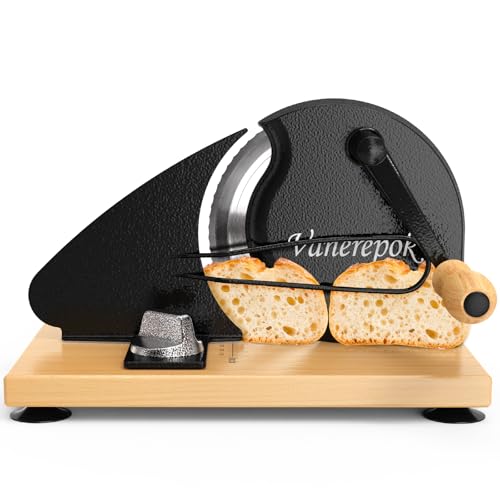
Vanerepok’s slicer features a steel wire guide rail that keeps slices aligned along the rail for smooth cuts. A gear-driven mechanism reduces effort, enabling steadier slicing of thicker loaves. Thickness is adjustable up to 0.8 inches, making it versatile for crusty rounds or sandwich breads. Built with sturdy materials and an ergonomic design, it aims to minimize wobble and deliver consistent slices, especially for sourdough enthusiasts who frequently bake substantial loaves.
Redants Manual Bread Slicer For Sourdough

The Redants slicer offers adjustable slice thickness from 0 to 0.8 inches with clear scale marks for precise cuts. It combines solid wood construction with non-slip suction cups to secure the unit during use, reducing movement. The blades are food-grade stainless steel, designed to deliver clean, even slices through crusty sourdough and softer breads. The design emphasizes safe handling and straightforward cleaning for frequent home bakers.
LukieBoee Bread Slicer For Sourdough

The LukieBoee slicer accommodates larger loaves with a 10.5-inch wide slot, ideal for sourdough rounds and artisan shapes. A stop board can be inserted into comb-like grooves to stabilize the loaf during slicing, reducing wobble. Guides help maintain uniform thickness for consistent slices suitable for toasting, sandwiches, or crusty bread plates. The durable frame and broad capacity make this model a practical choice for home bakers who regularly work with bigger loaves.
Buying Guide
- Thickness range: Prioritize models with adjustable thickness that match your bread types. For sourdough, a range around 0.8–0.9 inches supports crusty cuts, while 0.6–0.8 inches covers most toast and sandwich needs.
- Blade material and design: Look for food-grade stainless steel with serrated edges for clean cuts through crusty crusts without tearing the crumb. Easy blade replacement is a plus.
- Stability and mounting: Suction cups, non-slip feet, and solid bases reduce wobble. A wood or metal frame should feel sturdy and resistant to shifting during use.
- Capacity and slot width: Consider the maximum loaf width and length. Wider slots handle larger loaves, including sourdough rounds and baguettes, while compact models suit standard loaves.
- Ease of cleaning and maintenance: Choose slicers with smooth surfaces and simple disassembly for quick cleaning. Rust resistance and removable parts extend longevity.
- Ergonomics and safety: Comfortable handles, minimal pinch points, and guards help prevent injuries during quick slicing sessions.
- Parts availability and warranty: Check for replacement blades or spare parts and whether the manufacturer offers a warranty or after-sales support.
- Value for money: Compare features across models—multiple thickness settings, rails or guides, and stability features—to determine which model offers the best balance of performance and cost.
- Use case variations: If you bake in larger batches or routinely slice artisanal loaves, prioritize models with wider slots, robust construction, and stable operation over compact designs.
Across these five models, core capabilities align around adjustable thickness, durable stainless-steel blades, and stability-enhanced bases. The main differences lie in maximum thickness, the presence of a rail or stop-board system, and the capacity to accommodate larger loaves. For frequent sourdough bakers, prioritizing steadiness and the ability to cut evenly through crusty crusts will yield the most reliable results over time.