Best Air Purifier for VOCs and Formaldehyde: Top Picks for Safer Indoor Air
Selecting an air purifier that effectively targets volatile organic compounds (VOCs) and formaldehyde requires evaluating filtration styles, room coverage, and smart features. The five products below are chosen for strong VOC and formaldehyde performance, plus credible filtration configurations and real-world usability. Each option blends activated carbon or dual-action carbon filters with true HEPA filtration, plus features that help manage emissions from everyday sources like paints, cleaners, and furnishings.
| Product | Brand | Coverage | VOCs / Formaldehyde Focus | Filter Type |
|---|---|---|---|---|
| Jafända JF888 Large Room Purifier | Jafända | 3800 ft² | VOCs; activated carbon helps remove odors and VOCs | Ture HEPA + Activated Carbon |
| AIRDOCTOR AD3500 Purifier | AIRDOCTOR | Up to 1260 sq ft (2x/hour); 630 sq ft (4x/hour) | VOCs; formaldehyde removal with carbon filter | UltraHEPA + carbon VOC filter |
| Dyson Purifier Big+Quiet Formaldehyde BP03 | Dyson | Large spaces (high-flow purification) | Detects and destroys formaldehyde | HEPA H13 |
| PuroAir 400 HEPA Purifier | PuroAir | Up to 2000 sq ft | VOC removal; reduces smoke, odors | 3-layer filter system with activated carbon |
| Smart Air Blast Mini MKII Purifier | Smart Air | Up to 3075 sq ft | VOC removal; formaldehyde and other VOCs | H13 HEPA + optional VOC filter |
Jafända JF888 Large Room Purifier
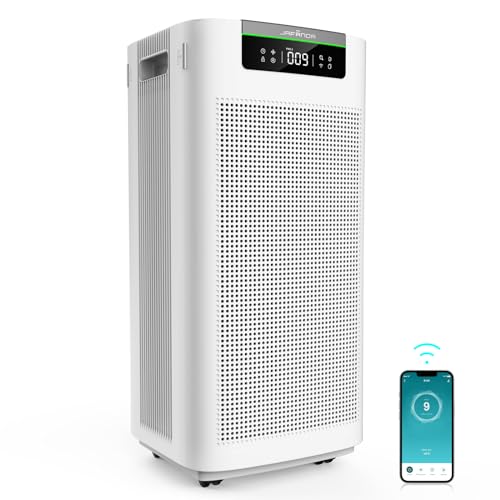
The JF888 model from Jafända is designed for whole-home use, with a CADR of 488 CFM and coverage of up to 3800 ft². Two fans deliver air through dual intake and dual-outlet pathways, supporting fast air cleaning large spaces such as living rooms and offices. The purifier supports Auto mode that adjusts the fan speed based on PM2.5 readings; its PM2.5 color indicator shifts through green, blue, yellow, and red to reflect air quality in real time. A VOC-friendly activated carbon filter works with the True HEPA stage to capture VOCs and odors. It’s compatible with Alexa and an accompanying APP for scheduling and remote control, enabling convenient monitoring of indoor air quality from anywhere.
Key features include a display that shows PM2.5, PM10, or PM1.0 values, and a responsive color-coded indicator linked to air quality. The model is suitable for large living rooms, classrooms, lobbies, and office spaces that require robust VOC control. Because it uses activated carbon in tandem with HEPA filtration, it provides a practical solution for reducing VOC exposure from paints, adhesives, and household cleaners. For users prioritizing voice control and smart scheduling, JF888 offers a strong, all-in-one package for VOC management in sizable areas.
AIRDOCTOR AD3500 Purifier

The AIRDOCTOR AD3500 uses a three-stage filtration system with an UltraHEPA filter and a proprietary dual-action carbon VOC filter. This design targets a broad spectrum of contaminants and is independently tested to capture very small particles, down to 0.003 microns, with a claimed 99.99% efficiency for airborne particles. It is well-suited for bedrooms, living rooms, and kitchens where VOC exposure can be a concern due to cooking fumes, cleaning products, or furnishings. Coverage is strong for mid-sized spaces, and the dual-action carbon filter adds a dedicated layer for VOC and formaldehyde reduction. The unit’s design emphasizes real-time air quality feedback, making VOC management more actionable in daily life.
Owners benefit from a reliable carbon-based stage alongside HEPA filtration, helping to mitigate odors and chemical emissions from everyday products. The AD3500’s focus on VOCs and formaldehyde makes it a practical choice for homes in newer buildings or spaces with recent renovations. While it excels in smaller to mid-sized rooms, pairing two units can extend coverage for larger areas or open-plan layouts.
Dyson Purifier Big+Quiet Formaldehyde BP03

Dyson’s BP03 is a large-format purifier designed for big spaces, with HEPA filtration and a focus on formaldehyde. The purifier’s capability to project purified air across substantial distances makes it a practical solution for open-plan living areas, studios, or lofts. A standout claim is its formaldehyde-destroying capability, which is particularly relevant for environments with volatile emissions from new furniture, pressed wood, or certain cleaning products. The device emphasizes performance over compact size, making it suitable for users who need a robust solution for formaldehyde and VOC reduction in sizable rooms.
Dyson’s filtration system uses HEPA H13-grade media, which helps capture a broad range of particulates, including pollen, dust, and smoke, while the formaldehyde-facing feature targets this common VOC. The BP03 is also designed for ease of use and aesthetic integration, offering a visually appealing option for households prioritizing formaldehyde mitigation in large living areas.
PuroAir 400 HEPA Purifier

PuroAir’s 400 HEPA purifier is marketed as a solution for large spaces, including options for a two-pack to extend coverage. The unit uses a three-layer filtration system that includes a pre-filter, HEPA, and activated carbon to address VOCs, odors, and general pollutants. It claims to filter up to 99.9% of pollutants, with a focus on VOC removal and odors from cooking, smoke, or household products. CARB, ETL, ISO, UL, and Energy Star certifications add a level of credibility to its performance claims. The purifier’s sensor-based operation helps adjust power to polluted air, which supports ongoing VOC management in busy homes.
For homes that require sustained VOC control across large living spaces, PuroAir 400 can be deployed as a 2-pack to ensure consistent air cleaning. Its combination of HEPA filtration with activated carbon targeting VOCs makes it a practical, scalable option for those prioritizing odor and chemical filtration in addition to particle removal.
Smart Air Blast Mini MKII Purifier

The Smart Air Blast Mini MKII is a compact unit with surprisingly high capacity, capable of delivering up to 860 CFM of clean air and claiming 3,075 square feet of coverage within 30 minutes. It uses an H13 HEPA filter to capture 99.97% of airborne particles, while an optional VOC filter can remove gaseous pollutants such as NOx, SOx, ozone, radon, and formaldehyde. This dual-filter approach makes it highly versatile for VOC control in spaces where formaldehyde and other VOCs are a concern, without occupying excessive floor space. For environments like home offices or classrooms where space is at a premium, the Mini MKII offers strong VOC filtration with a flexible configuration.
When selecting this model, consider whether you need the additional VOC filter for formaldehyde-heavy environments. The purifier’s compact design is a plus for bedrooms or small offices where quiet operation and energy efficiency matter. If you anticipate frequent exposure to VOCs from renovations or new furniture, the optional VOC filter adds an extra layer of protection without sacrificing the purifier’s core particle-cleaning performance.
Buying Guide: Key Purchase Considerations For VOCs And Formaldehyde
When choosing an air purifier for VOCs and formaldehyde, prioritize filtration chemistry, room size, and real-world usage. Below are core considerations to help balance performance with practicality.
Filtration Chemistry And Filter Life
Look for units that pair a high-quality HEPA filter with activated carbon or dual-action carbon filters. Activated carbon or dual-action carbon filters excel at absorbing gaseous pollutants, including formaldehyde and other VOCs, while HEPA captures particulate matter. Check replacement intervals and costs; carbon stages often require more frequent changes if you have high VOC exposure. CARB certification and independent testing (AHAM VERIFIDE or similar) provide confidence in performance and energy use.
Room Size And CADR
Match the purifier’s CADR and recommended room size to your space. Large rooms may benefit from high-CADR units or multi-unit configurations. For open-plan areas, consider models with dual intake/output or larger filtration stages to maintain consistent air quality. If you renovate or upgrade, choose a purifier that can scale with the room as VOC sources persist or expand.
Formaldehyde Specific Considerations
Formaldehyde is a common VOC from building materials and some furnishings. Units featuring dedicated carbon stages or dual-action carbon can more effectively reduce formaldehyde levels. In very formaldehyde-prone environments (new builds, recent renovations), prioritize models with proven formaldehyde targeting and additional sensors for continuous monitoring.
Noise, Energy, And Usability
Consider noise levels in sleeping or work areas. Look for Sleep or Quiet modes and energy-efficient operation. Smart features (APP control, voice assistants) help with scheduling and remote monitoring, but verify that the app integrates with your preferred ecosystem and offers set-and-forget scheduling for consistent VOC management.
Maintenance And Total Cost Of Ownership
Factor in filter life, availability, and replacement costs. Some brands offer filter subscription programs, which can simplify maintenance and ensure filters are changed at optimal intervals. A fresher filter generally yields better VOC performance and overall air quality improvements over time.
Performance Versus Practicality
For large spaces, a single unit with high coverage can outperform multiple smaller units due to uniform air turnover. If budget or space constraints limit you to one purifier, select a model that emphasizes high VOC reduction, strong CADR, and a filtration stack that combines particle and chemical filtration. When possible, pair a VOC-focused purifier with a second unit in a separate area to maintain broad, consistent air quality throughout the home or workspace.